Close


 Contact us
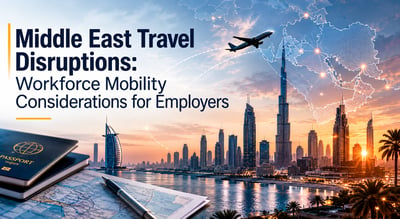
Middle East Mobility and Travel Update: Key Immigration and Compliance Considerations
.jpg?width=500&height=333&name=Middle%20East%20Mobility%20Update%20Travel%20Disruptions%20and%20Immigration%20Impact%20(2).jpg)
Overview
Recent escalation involving United States, Israel, and Iran has triggered widespread disruption across Middle Eastern airspace, rapidly impacting how people move, where they can go, and how long they can stay.
Flight diversions, route suspensions, and last-minute scheduling changes are affecting both commercial and corporate travel, with knock-on consequences for visa validity, permitted stay durations, and entry conditions across multiple jurisdictions.
Across key transit and business hubs such as the United Arab Emirates, Qatar, Kuwait, and Lebanon, mobility is no longer just a planning exercise it is an active, evolving risk environment.
Airports that typically function as stable connection points are now subject to sudden operational restrictions, heightened security procedures, and shifting government guidance. For employers, this creates immediate challenges around rerouting employees, managing duty of care, and maintaining business continuity.
This is not just a travel disruption it is a real-time stress test of mobility strategy, compliance readiness, and operational coordination.
Organizations must now reassess routing strategies, review visa and work authorization implications of unplanned stays, and ensure alignment across HR, mobility, security, and business teams. Speed of response and access to accurate information are becoming as critical as planning itself.
What’s Actually Changing (and Why It Matters)
1. Airspace closures are breaking travel predictability
- Flights are being suspended, rerouted, or cancelled with minimal notice
- Transit routes are shrinking, increasing reliance on limited corridors
- Arrival timelines are becoming unreliable even for confirmed travel
A confirmed itinerary no longer guarantees movement.
2. Borders are becoming conditional, not fixed
- Land border access is tightening or closing in some areas
- Travel bans are being introduced for specific nationalities
- Governments are urging citizens to return or avoid travel entirely
Mobility decisions now carry geopolitical dependency not just logistical planning.
3. Immigration systems are adapting but not consistently
- Visa extensions are being granted in some jurisdictions
- Overstay penalties are being waived or reduced in others
- Emergency entry/exit pathways are being introduced selectively
Similar cases can now result in different outcomes depending on location and timing.
4. Processing capacity is under strain
- Consular operations are reduced or temporarily paused
- Government offices are functioning with limited personnel
- Processing timelines are extending unpredictably
Even routine immigration processes are becoming operational bottlenecks.
5. Entry decisions are becoming less predictable
- Additional documentation may be requested at short notice
- Visa-on-arrival is increasingly discretionary
- Border-level decisions may override standard eligibility
Compliance alone no longer guarantees entry.
Regional Reality Check: Where Policy Meets Practice
While disruption is regional, responses remain highly localised:
- United Arab Emirates
Business support measures introduced, including administrative flexibility and cost relief - Qatar & Kuwait
Automatic visa extensions reducing immediate overstay exposure within defined conditions - Bahrain
Visa extensions and penalty waivers providing short-term relief - Israel
Visa validity extensions alongside reduced government service capacity - India
Support mechanisms for foreign nationals requiring visa extensions due to disrupted travel
These measures provide short-term flexibility but not long-term stability.
Policy responses remain fragmented, conditional, and subject to rapid change.
Who This Impacts Most
Employees in the region
Navigating restricted movement, limited travel options, and shifting local regulations
Individuals in transit
Facing delays, rerouting, missed connections, or uncertain onward travel
New hires and assignees
Experiencing disrupted start dates, delayed onboarding, or relocation uncertainty
Organizations managing regional mobility
Handling cross-border movement into or within the Middle East under rapidly changing conditions
Where Flexibility Helps and Where It Doesn’t
Temporary concessions are easing immediate pressure:
- Visa extensions reduce short-term overstay risk
- Penalty waivers provide limited relief
- Emergency travel pathways enable movement in specific cases
However:
- These measures are not consistently applied
- They vary significantly across jurisdictions
- They may change without notice
These measures address immediate symptoms not the underlying disruption.
Flexibility reduces pressure, but it does not remove complexity.
Compliance Obligations Persist but Are Becoming More Complex to Manage
- Visa conditions must still be actively monitored
- Concession timelines must be tracked closely
- Documentation requirements may shift without notice
- Entry outcomes may vary on a case-by-case basis
Inconsistent enforcement increases exposure even where compliance appears to be met.
Compliance is no longer a static checklist it is an ongoing, real-time responsibility.
What This Means for Employers and Mobility Teams
Organizations are now operating in an environment where:
- Travel plans can fail mid-journey
- Immigration timelines are no longer reliable inputs
- Decisions must be made with incomplete information
- Outcomes may differ despite correct preparation
Mobility management is shifting from structured planning to real-time coordination, adaptability, and execution speed.
Implementation and Next Steps
In a rapidly shifting environment, static plans are no longer sufficient.
What matters now is the ability to respond quickly with the right information and internal alignment.
Organizations should prioritise:
- Establish real-time visibility
Maintain accurate, up-to-date data on employee location, visa status, and travel plans - Reassess all active and planned movement
Review upcoming travel, relocations, and assignments against current restrictions - Strengthen cross-functional coordination
Align mobility, HR, travel, and security teams on response protocols - Communicate with clarity and frequency
Provide employees with timely updates and clear guidance - Activate contingency planning
Prepare for remote work, delayed start dates, or relocation adjustments - Monitor regulatory changes continuously
Track evolving government measures and adjust responses in real time
Execution is now the differentiator.
Organizations that respond faster and stay aligned will navigate disruption more effectively.
Key Takeaway
Mobility does not fail because of a lack of planning.
It fails when well-designed plans cannot adapt quickly enough to rapidly changing realities.
Even the most robust policies, routes, and assignment frameworks can become ineffective when airspace closures, shifting border rules, or sudden security measures invalidate assumptions within hours.
In today’s environment, success in global mobility depends on one capability above all: the ability to respond in real time.
This means being able to:
- Detect disruption early through reliable, up-to-date information
- Assess immigration, compliance, and duty-of-care implications immediately
- Decide and execute alternative routes, timelines, or work arrangements without delay
Organizations that build this responsiveness into their processes combining clear governance, empowered decision-making, and trusted advisory support are better equipped to protect employees, remain compliant, and sustain business continuity.
------------------------------------------------------------------------------------------------------------------------
About Anywr
Anywr is a French international group specializing in global mobility solutions.
Founded in 2012, Anywr operates in 12 countries across 4 continents. Our mission is to support companies in addressing their Human Resources challenges. We respond to your needs in terms of international mobility, particularly in terms of immigration policies, relocation, the implementation of mobility policies and EOR.
Do you have a mobility project for your teams? Contact us!