Close


 Contact us
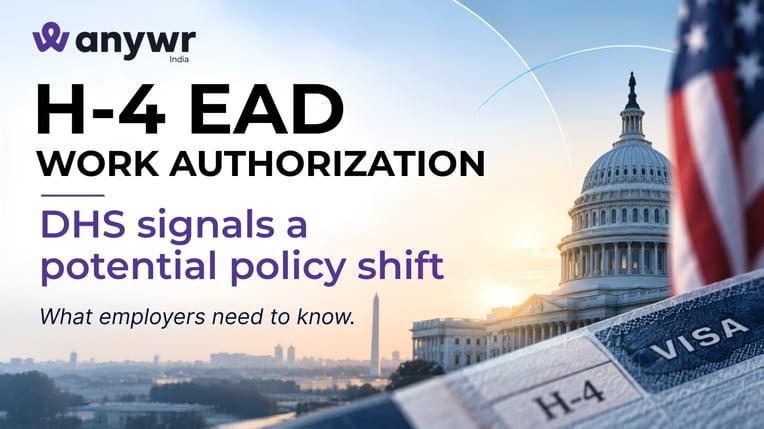
H-4 EAD Work Authorization: DHS Signals Potential Policy Change
Overview
A potential change to H-4 dependent spouse employment authorization could have implications beyond immigration compliance.
The U.S. Department of Homeland Security (DHS) has added a rulemaking initiative to the Unified Agenda that would reconsider employment authorization for certain H-4 spouses of H-1B workers. While no immediate change has been made, the development is relevant for employers that recruit, relocate and retain H-1B talent in the United States.
The initiative, identified as RIN 1615-AD14, would remove certain H-4 dependent spouses from the class of noncitizens eligible to request employment authorization under category (c)(26). DHS describes the initiative as a reversal of the 2015 rule that established employment authorization eligibility for certain H-4 dependent spouses.
The initiative is currently listed as a Long-Term Action, and DHS has not published proposed regulatory text or announced a date for a Notice of Proposed Rulemaking (NPRM). Current H-4 EAD eligibility therefore remains in effect.
For HR and Mobility teams, the question is not only whether H-4 EAD eligibility could change. It is also how a future change could affect U.S. relocation decisions, assignment acceptance, employee experience, recruitment and retention.
This article explains what DHS has signaled, what remains unchanged and what employers managing international talent should consider now.
What Is DHS Proposing?
DHS has placed RIN 1615-AD14 on the regulatory agenda to reconsider the employment authorization available to certain H-4 dependent spouses of H-1B workers.
Under the current framework, eligible H-4 spouses can apply for employment authorization using Form I-765 under category (c)(26). Eligibility is subject to specific requirements, including qualifying circumstances involving the H-1B principal worker's employment-based permanent residence process.
DHS's regulatory agenda describes the proposed action as reversing the 2015 rule that established this employment authorization pathway and returning to the previous policy under which H-4 dependent spouses were not eligible for this category of employment authorization.
However, DHS has not yet published the proposed rule itself.
This means employers currently do not have the information needed to determine the precise scope of any future change.
What Has and Has Not Changed?
This distinction is critical for employers and employees.
What has changed?
DHS has formally placed a rulemaking initiative concerning H-4 dependent spouse employment authorization on its regulatory agenda.
What has not changed?
At present:
- H-4 EAD eligibility under the current rules remains available to qualifying applicants.
- DHS has not published an NPRM for RIN 1615-AD14.
- No effective date for a new restriction has been announced.
- No final rule eliminating the current eligibility has been issued.
- No transition or grandfathering provisions have been announced.
- No new salary threshold has been introduced for H-4 EADs through this announcement.
DHS currently lists the NPRM date as “To Be Determined.”
Why does this matter?
A regulatory agenda entry is a policy signal, not an implemented rule.
Employers should therefore not make immediate changes to their current H-4 EAD support processes or communicate that H-4 employment authorization has ended.
The next substantive milestone will be publication of an NPRM. That proposal should provide more information about the scope of any change and how DHS intends to address existing EAD holders, pending applications, renewals and transition arrangements.
Who Could Be Affected?
If DHS ultimately moves forward with the proposal substantially as currently described, the most directly affected population would be certain H-4 dependent spouses of H-1B workers who currently qualify for employment authorization under category (c)(26).
The potential impact, however, extends beyond the individual EAD holder.
Employees and their families
A spouse's ability to work can be part of a family's decision to:
- Accept a U.S. relocation or assignment;
- Move to the United States;
- Remain in the country during a lengthy employment-based immigration process; or
- Continue building a long-term career in the United States.
A change to dependent work authorization could therefore influence household income, career continuity and the family's overall assessment of a U.S. opportunity.
Employers
The development is particularly relevant to organizations that:
- Employ significant H-1B talent;
- Relocate international employees and their families to the United States;
- Recruit specialized foreign national professionals;
- Manage long-term U.S. assignments; or
- Support employees progressing through employment-based permanent residence pathways.
For HR Directors, Global Mobility leaders, Immigration Managers, HR Business Partners, Talent Acquisition leaders and HR Operations teams, H-4 EAD developments should therefore be considered alongside broader workforce planning and employee mobility decisions.
Potential Workforce Impact
A change to dependent employment authorization could influence an employee's decision-making at several stages of the mobility lifecycle.
Recruitment
For international candidates evaluating a U.S. opportunity, the ability of an accompanying spouse to continue working may form part of the overall relocation proposition.
A future restriction could therefore become one factor candidates consider when comparing opportunities across countries.
Relocation
International relocation involves more than the employee's immigration status.
Families may also consider employment, financial and career implications before committing to a move.
Greater uncertainty around dependent employment could therefore become an additional consideration during U.S. relocation planning.
Assignment Acceptance
For employees being asked to undertake a U.S. assignment, family circumstances can influence whether the assignment is accepted.
Mobility teams may need to consider dependent employment authorization alongside immigration and relocation requirements when assessing the overall assignment proposition.
Employee Experience
An immigration development affecting a spouse can create significant questions for employees even when the employee's own H-1B status remains unchanged.
Clear, timely communication and access to accurate information can become particularly important as employees and their families assess the potential implications.
Retention
For some H-1B professionals, their spouse's ability to work may contribute to the decision to remain with an employer or continue living in the United States.
If H-4 EAD eligibility is ultimately restricted, employers could face additional retention considerations within affected talent populations.
The broader consideration for employers
A dependent immigration change can become a workforce mobility issue.
For organizations managing international talent, this means immigration policy developments should be considered not only from a compliance perspective, but also in the context of recruitment, relocation, assignment planning and retention.
Compliance Considerations for Employers
There is no new H-4 EAD compliance requirement to implement today as a result of the regulatory agenda entry.
Employers should continue operating under the rules currently in effect.
USCIS's current Form I-765 instructions continue to recognize category (c)(26) for eligible H-4 spouses of H-1B nonimmigrants, subject to the applicable eligibility requirements.
Employers should therefore not:
- Treat the regulatory agenda entry as an effective rule;
- Assume existing H-4 EADs have been cancelled;
- Stop supporting eligible H-4 EAD processes based solely on the announcement;
- Ask employees to establish a different employment authorization basis solely because the initiative has been added to the agenda; or
- Communicate an H-4 EAD termination date that DHS has not established.
Employment verification should continue to follow the applicable Form I-9 requirements and current employment authorization rules.
Any future change should be assessed against the actual regulatory text, effective date and transition provisions issued by DHS.
What This Means for HR and Mobility Leaders
For employers managing international talent, the key question is not simply:
Will H-4 EAD eligibility change?It is:
What could a change mean for the way we recruit, relocate, support and retain international employees?
Different functions may need to consider different aspects of the development.
Global Mobility Teams
Review whether dependent employment authorization is considered when employees evaluate U.S. assignments and relocations.
Where it is relevant, understanding the potential exposure early can help mobility teams assess how a future policy change could affect assignment decisions.
HR Leaders
Consider whether a future restriction could create employee-relations or retention concerns among affected H-1B populations.
HR teams should also ensure that employees receive consistent information as the regulatory process develops.
Talent Acquisition Teams
Understand whether dependent employment authorization forms part of the relocation proposition communicated to international candidates.
This may become particularly relevant when competing for specialized talent in markets where accompanying-spouse work authorization differs.
Immigration Teams
Monitor the Federal Register and DHS announcements for proposed regulatory text.
Once an NPRM is published, immigration teams can assess the actual proposed eligibility changes and any provisions affecting existing or pending cases.
HR Operations and Mobility Coordinators
Establish clear internal ownership for monitoring, employee questions and communications.
This can help prevent an early policy signal from being interpreted internally as an immediate change in employee work authorization.
What Employers Can Do Now
Because no immediate rule change has occurred, the appropriate response is preparedness rather than premature operational change.
1. Map potential exposure
Where appropriate and consistent with privacy and data-handling requirements, identify workforce populations where H-4 dependent employment authorization may be relevant.
The objective is to understand potential exposure, not to make assumptions about individual employees.
2. Coordinate Immigration, HR and Mobility Teams
Establish clear ownership for monitoring the development, reviewing future regulatory text and coordinating employee communications.
A coordinated approach can reduce the risk of different teams providing inconsistent information.
3. Review U.S. Relocation and Assignment Processes
Consider whether dependent employment authorization is currently addressed when employees evaluate U.S. assignments and relocations.
Understanding where this factor matters to your workforce can help identify potential operational exposure if DHS proceeds.
4. Prepare an Employee Communication Approach
Develop a clear process for communicating future developments to affected employees.
For now, the message should remain straightforward:
There is no immediate change to H-4 EAD eligibility.
5. Monitor the Formal Rulemaking Process
The regulatory agenda provides an early indication of DHS's policy direction. The publication of an NPRM will provide significantly more information about the proposed scope, timing and treatment of existing cases.
What Happens Next?
If DHS proceeds with the initiative, the next major milestone would be publication of a Notice of Proposed Rulemaking (NPRM).
The regulatory process would then generally involve:
1. Proposed Rule
DHS publishes proposed regulatory text in the Federal Register.
2. Public Comment
Employers, industry groups, immigration professionals and other stakeholders have an opportunity to review the proposal and submit comments.
3. Agency Review
DHS considers the submitted comments and determines whether and how to proceed.
4. Final Rule
If DHS decides to move forward, it would publish a final rule establishing the final requirements and effective date.
5. Implementation
Employers would then need to assess the final requirements, including any provisions addressing existing EAD holders, pending applications, renewals and transition arrangements.
At present, DHS has not provided an NPRM date for RIN 1615-AD14.
What Employers Should Watch
For HR, Immigration and Global Mobility teams, the following developments will be particularly important:
- Publication of the NPRM and the precise proposed eligibility changes;
- Treatment of existing H-4 EAD holders;
- Treatment of pending applications and renewals;
- Any grandfathering or transition provisions;
- The proposed effective date;
- The public-comment period and deadline; and
- Any subsequent final rule or implementation guidance.
These details will determine whether and how employers may need to adjust immigration, mobility and employee-support processes.
Until those details are published, employers should avoid making assumptions about how a future rule would affect individual employees.
Key Takeaway
DHS has signaled a potential policy change to H-4 dependent spouse employment authorization, but H-4 EAD eligibility has not been eliminated.
RIN 1615-AD14 is currently listed as a Long-Term Action on the 2026 Unified Agenda, with the NPRM date still to be determined.
For employers, the immediate priority is visibility, not disruption.
Organizations employing H-1B talent should understand where dependent employment authorization may intersect with recruitment, relocation, assignment acceptance, employee experience and retention, while continuing to operate under the rules currently in effect.
The next meaningful regulatory trigger will be publication of the proposed rule. That is when employers will have the information needed to assess the scope of the proposed changes and determine what action may be appropriate.
For employers managing international talent, immigration developments can have implications well beyond visa eligibility. Changes affecting employees and their dependents can influence relocation decisions, assignment planning and retention.
Anywr India helps employers navigate Immigration and Relocation requirements as they manage international workforce movement. We will continue to monitor this development and assess its implications as DHS provides further details.
This article is intended for informational purposes only and does not constitute legal or immigration advice. Immigration requirements and applicability may vary depending on permit category, local regulations, and individual case circumstances. For tailored guidance specific to your organisation’s needs, please reach out to Anywr’s immigration experts for a consultation.
------------------------------------------------------------------------------------------------------------------------
About Anywr
Anywr is a French international group specializing in global mobility solutions.
Founded in 2012, Anywr operates in 12 countries across 4 continents. Our mission is to support companies in addressing their Human Resources challenges. We respond to your needs in terms of international mobility, particularly in terms of immigration policies, relocation, the implementation of mobility policies and EOR.
Do you have a mobility project for your teams? Contact us!